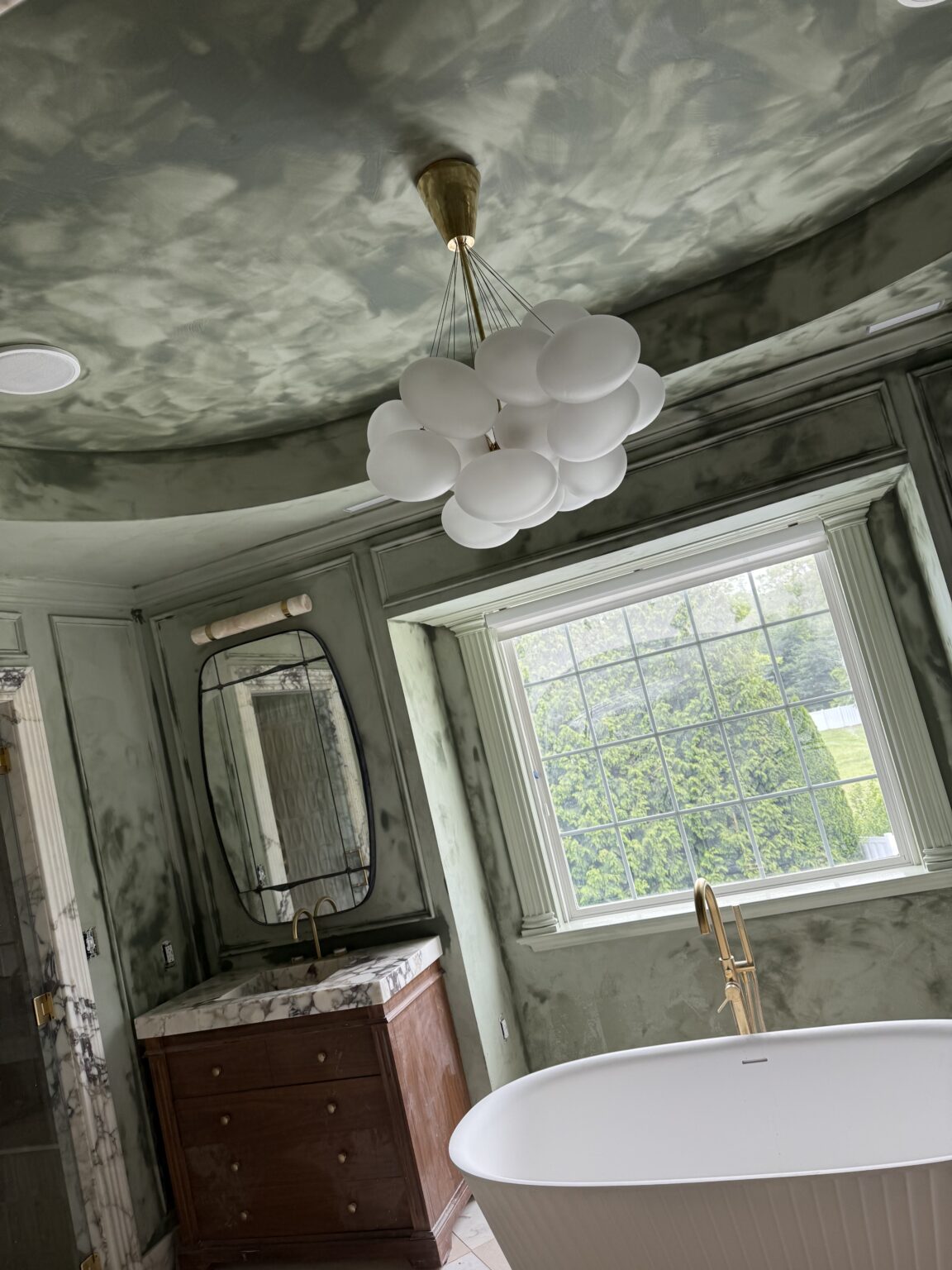
Limewash is lime, water and pigment. That's nearly all of it. On bare brick or plaster it soaks in instead of sitting on top the way latex paint does, and it hardens slowly, over several weeks, by pulling carbon dioxide out of the air. The result is the soft, cloudy finish you see on limewashed fireplaces and feature walls.
It can go over painted walls as well as brick, bathrooms included, as long as the wall is properly prepared and sealed where it will be touched or splashed. It is the wrong finish for a few walls, and a wet sample will fool you.
What limewash is made of
Limewash starts as slaked lime, which is calcium hydroxide, stirred into water with mineral pigments for color. Once it is on the wall it cures by absorbing carbon dioxide from the air and slowly turns back into calcium carbonate, the mineral limestone is made of. The UK conservation publication Building Conservation explains the chemistry, and notes that curing slows down in cold or humid weather.
Because it soaks in and forms no film, limewash wears away gradually over the years. On masonry it is also far more breathable than many masonry paints: Building Conservation's figures make it more than four times as vapor-permeable, which lets damp brick dry out rather than trapping water behind a skin of paint. Over painted drywall, the paint underneath sets the limit.
The finish is matte, with visible brush marks and cloudy shifts in tone, and it ages gracefully. That is the point. If you want an even color from corner to corner, buy paint.
Where limewash works in a Michigan house
A single feature wall is the request we get most often: an entryway, a powder room, a fireplace surround. A whole room works in the right space, particularly bedrooms and entryways, and in a busy entryway we seal the walls that take the traffic.
Bathrooms are one of our favorite places for limewash, provided the wall is sealed for the moisture. A bathroom will also take longer to cure than a living room, because limewash cures more slowly in cool or humid air, so ask us about timing before the first hot shower.
Unpainted, unsealed brick is where limewash is most at home, which makes a brick fireplace surround a natural candidate: the brick takes the wash directly once it is clean, and its texture still shows through. Painted brick is different. Romabio's technical data sheet recommends its limewash for unsealed, unpainted masonry and calls for a primer before it goes over paint, so if your brick has been sealed or painted, mention it when you send the photo.
Where limewash is the wrong choice
Hands are the problem. Romabio's data sheet says plainly that limewash is not oil proof, that foods, grease, body oils and crayons can damage it, and that cleaning can change the sheen. That rules out an unsealed finish on a mudroom wall, or on the stairwell wall that everyone in the house steadies themselves against on the way down, because that is exactly where the oils from a year of hands collect.
In rooms that need to be wipeable, we seal accordingly. Sealed or not, these are not scrub surfaces.
In a basement, fix any water coming through the foundation first. No decorative finish will hold it back.
Can limewash go over painted drywall?
Usually. The existing paint has to be sound, and the wall has to be primed properly. Limewash cannot soak into a latex film, so it needs a primer made for it. Romabio's data sheet says its limewash cannot go directly over latex, acrylic or oil paint without a coat of its MicroGrip primer, and James Alexander's drywall guide calls for a regular water-based primer on new drywall first, then its own mineral primer on top.
The wash then typically goes on in two thin coats with a brush, worked while it is wet. Texture is unforgiving of what is underneath, so the prep matters even more than usual, and nail holes and dents get filled and sanded before any primer goes on.
Why you should not judge a sample wet
Limewash dries many shades lighter than it looks in the bucket, a quirk Building Conservation warns about. Judge a sample only once it is fully dry, in morning and evening light. A north window and a west window can make the same wash look noticeably different.
It keeps hardening, too. Romabio's data sheet puts full calcification at 20 to 25 days at the earliest, at 68°F and 60% humidity, and a cool basement room in a Michigan January will take longer than that. That is why we always start with a sample board or a test area before we commit the room.
Limewash or textured plaster?
Limewash is thin and brushed on, so the color moves but it adds no texture of its own. Textured plaster is built up in layers and worked by hand, which gives the wall real relief and shadow. If you want the wall to look soft and old, limewash gets you there with thin coats. If you want relief you can feel, you want textured plaster. Both are handwork.
For some rooms it is a genuine toss-up, and the fairest way to decide is to see a sample of each in that room's own light, at the times of day you actually use it.
What the job looks like
A feature wall usually takes a couple of days, including prep. The layers are worked while wet and given time between coats. Limewash costs more than regular painting because it is slower, hand-applied work and the materials cost more. For a single wall the difference is usually modest.
Day to day, wipe the wall with a clean, soft cloth and dab marks gently with a damp one. Never scrub. On an unsealed wall, cleaning can change the sheen. If there is leftover mix, keep it sealed tight for touch-ups.
If you are weighing limewash for a wall, send us a photo of it and tell us which way the window faces. We will tell you honestly whether the finish suits the space and what it takes to do it properly, and if it does, we will start with a sample board or a test area judged in that room's light. More of our work is on our specialty finishes page, and if the harder decision is the tone, a color consultation is the place to start.